Monday, June 14, 2010

Blog Reflections

This year, I have made considerable progress in my writing and reading. My blog focuses on who I’ve been as a reader and writer in the past, who I currently am as a reader and writer, and who I hope to become as a reader and writer. This development can be clearly seen through reading over my past blogs. When I reviewed all my previous blogs, I realized that my writing style and way of communicating through my writing, as well as my comprehensive reading, has developed throughout the 2009-2010 school year.


Some specific ways my writing has improved throughout the year include my use of more specific detail and more thoughtful word choice. For example, my most recent blog entry was a self evaluation of my abilities to write essays. In this blog entry, I used details about my strengths and weaknesses and places to improve as a writer. In my earlier entries, I spoke more generally about the topics in my blog.


Another area I feel I’ve improved in my writing is my knowledge of different devices to utilize in my posts. Experimenting with writing in different forms helped me practice variety, which is an important step to becoming a better writer. For example, on December 16, 2009, I posted a narrative poem inspired by Animal Farm. In doing this, I learned how to apply different poetic devices such as rhyme scheme and figurative language. In addition, I wrote a few reflections on past experiences in first person (October 14 about childhood memories and October 30 about life lessons). Doing so prepared me to use my own background experiences when reading the words of others.


This year I have grown in the use of applying my own experiences – from past relationships and lessons – to connect with texts I read. For example, on February 26, when I wrote about Great Expectations and Pip’s first visit to Miss Havisham’s house, I was able to relate to what Pip must have been experiencing by recalling my own experience at a summer camp (see photo above). Both Pip and I had an experience that changed the rest of our lives. Through this year, I have learned that when I apply my background knowledge when reading, I will better connect with what I am reading. There is a quote by Catherine Drinker Bowen that reminds me of how everything I write or read is connected to those things I have experienced. Bowen says, “Writing, I think, is not apart from living. Writing is a kind of double living. The writer experiences everything twice. Once in reality and once in that mirror which waits always before or behind.” I found these words to be true this year each time that I felt like I could identify with a character because I had experienced something similar in my own life.


Another area I grew in my language arts skills this year was further development of reading comprehension. We learned about literary elements such as motif, themes, and many more. My blog shows evidence of my developing understanding of these literary devices when I wrote about Barbara Kingsolver’s novel The Bean Trees on October 1 and 14. When I first started reading The Bean Trees, I could apply only prior knowledge of literary devices. However, as my abilities as a reader advanced, my perspective of the novel changed. And I began to develop a deeper understanding of the characters and theme. I was able to identify the writer’s use of motif in illustrating her theme. My post on November 18 about To Kill a Mockingbird demonstrates how my understanding of motif grew as I continued to write about it and identify it in what I am reading.


I have grown as a reader and a writer this year, and my blog illustrates this growth. I am excited to refine the skills I have learned this year and add even more to my toolbox. Through this process I’ve learned that writing about what I read as well as expanding my literary background help my thoughts and perceptions of what I am reading to become deeper and more complex. Perhaps I will continue to keep a blog in my future!

Friday, May 21, 2010

Essay Writing

Over the last few months in Honors English, I have learned a great deal about writing essays. And I hope to only get better in the future. Becoming skilled at analyzing literature is one of the most helpful things I can learn. Literary analysis is "reading between the lines" in a piece of writing. This can involve searching for figurative language, symbols, themes, character development, and more. Knowing I will write an essay drives me to read critically and be more in depth and aware of the author's style and purpose. It is critical to be creative and make inferences about a text, even if it is far beyond what the author had hoped for readers to understand.

Although my essay-writing abilities are improving constantly, there are still quite a few things I struggle with. One of these is three-fold transition sentences. I can find information/quotations and express my own thoughts on it, but I often have trouble tying a brief review of one body paragraph, a brief preview of the next paragraph, and reiterate part of the thesis all into one sentence. But if I keep working at it, perhaps I will find this part a breeze by the time Honors 10 rolls around!

Thursday, May 13, 2010

Summer Reading List

I love summer... having tons of time on your hands to do whatever you want. One of the things I love to do is catch up on reading the books that I want to read (not for assignments). Here are some of the books I'm hoping to read this summer:

1. Beautiful Boy by David Schiff: My mom read this book this past year and fell in love with it. It is an inspiring story from a dad's perspective about his teenage son. His son had been an honors student who was very involved in many activities. But this boy's world fell apart when he became addicted to meth. Beautiful Boy is an account of this boy's journey and struggles through his teenage years.

2. Three Little Words by Ashley Rhodes-Courter. This is another recommendation from my mom. It is about a girl who has been in and out of fourteen foster homes the majority of her childhood. She struggles with many things - going to new schools, having abusive foster families. Three Little Words tells about how she finds herself and how she succeeds despite these hardships.

Friday, May 7, 2010

Fate

I was born on January 10, 1995. My zodiac sign is Capricorn. Capricorns generally desire to be admired by their family and friends. We are quiet and patient and often acheive goals and complete tasks because of our determination. We are responsible, hard workers, and ambitious - in other words, workaholics.

I find that I relate to certain aspects of these predictions more than others. I am self-conscious and afraid of displeasing people. I am very introvertive, and therefore quiet and patient. I am not quick to express my inner feelings. Often times, if I dedicate my self to a job, I will complete it to the best of my abilities. I believe that I am a responsible and ambitious person, but not a workaholic. I still leave a place in my life for fun.

I can see how Romeo and Juliet's unity could partly be due to fate. Where barriers would ordinarily stand in their way, they disappear in time for these two to meet. And, as all things in fate work out, it must end at some point. Some call it the "Wheel of Fortune." The couple starts out at the top, and ends up at the bottom. What goes around comes around.

Thursday, April 29, 2010

Culture Shock

Romeo and Juliet is perhaps the most classic love story of all time. Because of this, it is quite commonly referrenced in modern-day books, songs, movies, etc. Just the other day, when I was watching Glee, I stumbled across one of these allusions. The first song April and Will sang together after reuniting was "Fire," originally by the Pointer sisters. Since I had less than an hour ago finished the night's reading of Romeo and Juliet, my ears perked up when I heard those words. What a coincidence! Although the song may be about a completely different romance than the play, it was still exciting to hear it. The verse that referrences Shakespeare's play goes:

Well, Romeo and Juliet, Samson and Delilah
Baby you can bet a love they couldn't deny
My words say split, but my words they lie
'Cause when we kiss, ooh, fire

http://www.youtube.com/watch?v=-qBE6GhFafk

Friday, March 26, 2010

Great Expectations: Skit

  • One good scene for a skit is when Pip encounters the convict for the first time in the churchyard. This is an important part of the book, and is tied back into the story later on. There is also a good contrast in the characters' personalities: Pip is polite and innocent and the convict is gruff and threatening.
  • Another part of the book that is crucial to the story is when Miss Havisham begs Pip on her knees for forgiveness. She has finally realized what she has done and how she brought Estella up, teaching her all the wrong morals.
  • One final suspenseful scene is the background story of Compeyson (as told by Magwitch). This shows just how evil this man is and the reasons for Magwitch and Miss Havisham's grudges on him. Perhaps the most exciting part of this section is when Arthur dies after seeing Miss Havisham's "ghost," since this scene is so dramatic.

Friday, March 19, 2010

Another Question

One thing I didn't understand in this week's reading (chapters 36-44) was when Magwitch tells Pip the story of his life and he talks about Compeyson's background as well. Compeyson's friend, Arthur (Miss Havisham's brother) sees a vision of Miss Havisham. He is deathly afraid of her, and says she is trying to put her shroud on him (and will at 5 in the morning). This whole incident is a little confusing to me. Does Arthur really see a ghost of Miss Havisham? Compeyson says this is impossible, since she is still living. So if Arthur really imagined the whole thing, how did he die?

Friday, March 12, 2010

Great Expectations: Question About Estella

One part of Great Expectations I didn't understand was on page 226, chapter 33. It is when Estella arrives at London and Pip takes her to tea. When asked why she will be going to Richmond, Estella replies:

"I am going to live at a great expense, with a lady there, who has the power - or says she has - of taking me about, and introducing me, and showing people to me and showing me to people."

I understand that Estella will be living there to be introduced to the "high-society" people there, and to learn her way around, but I don't understand why. Throughout the story, Miss Havisham is trying to throw Pip and Estella together (mainly so Estella can break his heart), so why would Miss Havisham send Estella away to Richmond, especially if she might meet new people and fall in love with someone else?

Friday, March 5, 2010

Great Expectations: Photo Post


I chose this photo of a bridge because it represents Pip's journey throughout his life. Pip is given the opportunity to step out of (what he thinks of as) the shadows of his old life as a blacksmith and into the sunlight of his new life as a gentleman. Pip boldly takes this leap, although there might be hardships on the path ahead. Part of his "great expectations" will require always traveling forward on the path, and never looking back. This might be hard for Pip in the future, and he might find that he should have cherished those younger days more. Pip will soon discover what the path laid out before him by his great expectations will really mean for his life.

Friday, February 26, 2010

Great Expectations: The First Stage

Pause you who read this, and think for a moment of the long chain of iron or gold, of thorns of flowers, that would never have bound you, but for the formation of the first link on one memorable day.

Pip's clever analogy refers to different paths one may choose in life. Once the first "link" is formed and the "chain" begins to grow, there is no going back. For Pip, this first link is forged when he visits Miss Havisham for the first time. Pip's peculiar and unexpected experiences at Miss Havisham's results in a myriad of new feelings. After becoming accustomed to the fine, high class luxuries of Miss Havisham's mansion, Pip feels ashamed and self-conscious of his own home. He is slightly obsessed with Miss Havisham and Estella and his short visit with them. He keeps thinking about his visit constantly and can't wait to go back.

When I was ten years old, I went to Cascades Camp as a camper for the first time. Although I had visited with my family before, this was different. I would stay in a cabin with a counselor and several other girls. Not knowing anybody at first left me feeling lonely and homesick, but as the days and week progressed, I made many friends and had the best experience of my life. By the end of the week, I was confident and open with all my new friends. Every summer since that first week at Cascades, I have returned to camp. I hope my chain will stretch into the future when I can become a counselor myself.

Tuesday, February 9, 2010

Group Essay

Thesis: The strongest of relationships can make it through even the most dramatic and unexpected catastrophies. In The Importance of Being Earnest, a play written by Oscar Wilde, three durable relationships have connections stronger than the obstacles they must overcome. Algernon and Cecily, Jack and Gwendolen, and Miss Prism and Chasuble have similar characteristics that naturally draw each couple together.

Each and every one of the relationships in The Importance of Being Earnest has overcome obstacles. Perhaps the most mature relationship in the play is between two middle-aged adults of the working class. Even before Miss Prism and Chasuble express their love for each other, they subtly break down barriers just to spend more time together. Miss Prism makes up a headache, which is an excuse to be with Chasuble. Even though Miss Prism obviously doesn't really have a headache, and Chasuble most likely knows this, he doesn't object. Miss Prism and Chasuble often also flirt and drop hints to say that they are interested in each other. Miss Prism advises Dr. Chasuble that he should get married. Miss Prism and Chasuble display in this conversation that their personalities are similar. They are forward with their feelings without being candid. One of the biggest obstacles in relationships are personalities that clash. After finding out that Miss Prism didn't have a child out of wedlock, Chasuble and Miss Prism embrace each other. Their feelings are finally revealed. There are no linger any secrets between Miss Prism and Reverend Chasuble, and the two freely express their love for each other.

Each of my concrete details and commentaries ties back to the theme of obstacles that are overcome.

Thursday, January 28, 2010

The Importance of Being Earnest/Victorian Research

In Victorian English times, women were treated unfairly with fewer opportunities than men. This started at a very young age. While the boys learned math and law, the girls were taught French, drawing, dancing, and music. Girls might also learn sewing or needlework. In most cases, their entire schooling was at home with a governess. Job opportunities for lower-class women were limited as well. Some job possibilities for a lower-class Victorian woman might be baking, seamstressing, being a domestic servant, working in a textile and clothing factory, or being a laundry worker. Even though upper-class women didn’t work, they were still treated poorly.

This poor treatment of women is reflected in Oscar Wilde’s The Importance of Being Earnest. Victorian women had little or no say in their life choices. One such woman is Gwendolen, who expresses, “Few parents nowadays pay any regard to what their children say to them” (53). Not only did parents not listen to their children, these parents offered their daughters no choice in whether or not to get engaged. On page 44 of the play, Lady Bracknell scolds Gwendolen, “Pardon me, you are not engaged to anyone. When you do become engaged to some one, I, or your father, should his health permit him, will inform you of the fact.” It is completely up to Gwendolen’s parents to choose her husband, and once a husband is chosen, it will be up to him to make the rest of her life choices. Although upper-class women were free of the hardships of working, they still were unequal to men.

Tuesday, January 5, 2010

2010 Resolution

When I think back over the past year and consider what I would like to do differently this year, a few things come to mind. One is to get more physical activity. From the time I was in preschool until eighth grade, I played soccer on a rec league. The team I had stayed with the whole time (Blue Ice) quit playing together. I missed going to practices in the evening after finishing my homework and burning off the steam had built inside me all day. Now with much more homework than before and more time consuming activities, I don't get much time to exercise.

This next year, I would like to change that and get at least two hours of physical activity each week (not counting PE). I can accomplish this in a variety of ways. Some ideas are to work out at the YMCA, go for walks or jogs or to just go outside and shoot hoops. I could exercise during family activties, too, such as going on hikes. Even though there may be come weeks where it is nearly impossible to get two hours of exercise in, I could strive to make it up the next week so that it averages out to two hours. I hope I can make my ambition to become physically active last throughout the year 2010.

Wednesday, December 16, 2009

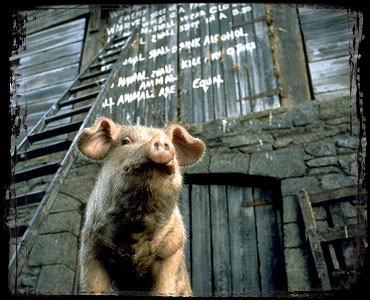
Animal Farm: Narrative Poem


Beast of England

Late one night on an English farm,
An old boar had a dream.
He gathered his fellow animals
To tell them of his scheme.

In old Major’s hopeful dream,
No humans were around.
The animals were free to rule,
And claim their piece of ground.

When old Major died,
His dream lived on within
All comrades worked together
To gain a victorious win.

Snowball and Napoleon,
Two pigs each with a snout
Led a rebellious riot
To drive the humans out.

After all was said and done,
Seven laws were written down,
Concerning the enemy –humans–
And their evil ways in town.

No animal should wear clothes
Or kill another beast.
No alcohol would be allowed
Obey these rules at least.

Two legs makes an enemy
Four legs makes a friend
All animals are equal
But then it all depends…

Craving the power for himself
Napoleon chased off Snowball
He convinced the other animals
This was better for them all.

One by one the rules were changed
Alterations made left and right
All seeming to benefit the pigs
And fill the rest with confusion and fright.

Napoleon changes one that clearly states,
No animals sleep in beds.
The new rule makes beds okay, but
Outlaws sheets instead.

All the rules are eventually lost
Power’s corruption is clear to see.
Yet the ignorant animals are oblivious
And keep on laboring readily

Late one night on an English farm,
The animals peered inside.
Napoleon had become quite human-like
And old Major’s dream had died.

Friday, December 4, 2009

Poetry Out Loud Performances: "Frederick Douglass"

Shawntay A. Henry's performance of the poem "Frederick Douglass" contained many exemplary characteristics for reciting poetry. Shawntay's physical presence as she began to speak seemed strangely unsure. But after only a few words, I could see that she was trying to convey a message to the audience. Her use of hesitation every once in a while made me recognize the dramatic tone of the poem. Through hand gestures, emphasis of certain words, and clear articulation, Shawntay displayed her maturity, poise, and deep understanding of the poem. The complexity of the theme of "Frederick Douglass" was thouroughly revealed through Shawntay A. Henry's performance.

Robert E Hayden's "Frederick Douglass" portrays the importance of freedom.
Freedom is as essential to life as air. Frederick Douglass was a slave who escaped and helped with the abolition of slavery. Because of him, many black slaves became free men and women. This poem honoring Frederick Douglass explains how vital freedom is. After hearing the poem, I finally learned to appreciate how privileged I am.

Wednesday, November 18, 2009

Mockingbird Motif

A motif is a reappearing object, idea, or arrangement in a peice of writing. Authors use motifs to show a main idea or theme throughout a novel or other writing. In To Kill a Mockingbird, for example, Harper Lee uses a reoccurring symbol throughout the novel of a mockingbird. Atticus tells his children in the story that it is a sin to kill a mockingbird. Miss Maudie adds to this by saying, "Mockingbirds don't do one thing but make music for the rest of us to enjoy." This helps enhance the mockingbird motif.

A metaphorical mockingbird is an innocent person who does things for the benefit of others. Two of the mockingbirds in the story are Tom Robinson and Boo Radley. Through revealing their similarities to mockingbirds, Harper Lee creates a closer feel for their lifestyles. A black man, Tom Robinson tries to do nothing but innocently help Mayella Ewell and is found guilty of raping her. Tom is a victim of unjust prejudice. Boo Radley stays in his house day after day, not harming anybody, but (if anything) helping them. Boo Radley helps Scout to grow in acceptance and understanding of differences. He helps her also to comprehend Atticus's words that she'd never understand another person until she stood in their shoes. These are just two examples of mockingbirds that Harper Lee uses to emphasize the major themes of the novel.

Saturday, November 14, 2009

Scout: Compassion


In the selection I read of the dramatic reading, Scout realizes how Mayella Ewell "must have been the loneliest person in the world." And, as Tom Robinson continues his testimony, Scout sees that he will be punished for nothing but showing kindness to Mayella. Scout becomes compassionate toward Tom, but at the same time takes some pity on Mayella Ewell. The hands represent the sympathy Scout feels for others, even if the rest of Maycomb is too prejudiced to have kind feelings.


Friday, November 6, 2009

Life Lessons

I was only six when my sister left for college. As her nerves were building when she was preparing to move out, it seems everyone had some sort of advice for her. One of these helpful hints is perhaps the best life lesson I have ever learned. A saying my grandma often said was, "To have a friend, you have to be a friend." Although I didn't realize it at the time, my grandmother's simple yet wise cliché is something I will have with me for the rest of my life.

This powerful phrase is a motto that I do my best to follow. Whenever I don't know how to handle a situation, I can turn to this lesson, and my life becomes clearer. As I have grown older, I have realized how much an easy task such as being a friend can impact my life and the lives of people around me. Sometimes all people need is someone to be there, through thick and thin, including me. A friend will cheer me up on a bad day and laugh with meon a good day. A friend will be there for me when times are rough. And the best way to have someone there for me is to be there for them.

Friday, October 30, 2009

My Sister; My Friend

I guess I should call myself lucky. I have the best sister and friend in the world. My friendship with Kristen is closer than with anybody else. We talk on the phone for hours about nothing in general. We can laugh until we cry (literally) but can later have serious life conversations. Kristen collects Curious George memorabilia and loves to watch sunsets. She has some very adorable clothes that she always lets me borrow whenever I want. We have everything in common with each other. She is always there for me and helps me with any problems I might have.

Kristen is by far the nicest person I know. She is -unlike what she believes- completely selfless. She could definitely be described as an altruist: she is often concerned about the well-being of others. She is a creative and unique person, and is -in many aspects of life- is my inspiration. Although we don't always see eye to eye (as I'm sure all siblings do) I love my sister.

Tuesday, October 20, 2009

Point of View: 1st person


Some of my favorite childhood memories lie in a large, blue Rubbermaid box. This bursting-at-the-seams box contains oodles of dress-up clothes, which have brought countless hours of fun to me and all my friends. Perhaps the best times dress-up provided were with my two closest cousins. Although their visits were rare, and we didn't see each other much, by the time we really got into dress-up, we would be the best of friends. It was always the same at any occasion they visited for: the grown-ups would all sit in the living room having "boring" conversations. The youngest of the three of us, Brad, would run out in the living room, and announce the characters: "Introducing the clown princess and hat lady!" Then Angela and I would waltz in costume into the living room and give a fashion show for the adults. We were butterflies and hula dancers. We were pilgrims and Indians for Thanksgiving, and reindeer for Christmas. Afterwards, we'd run back to my bedroom for a costume change.

Our shouts could be overheard through the closed door. "I want to be the fairy."

"No fair, you got to be it last time." Reaching my tiny hand into the giant box, I'd pull out a purple feather boa - the perfect match to my ballerina tutu. Angela picked out costumes for her brother, Bradley. He would argue with outbursts such as, "Boys don't wear dresses!"

We would always work out the costumes and look great for our parents and grandparents who would often applaud but would sometimes ignore us and rudely carry on their chit-chat.
The box now sits in storage, but once in a while I rummage through it to find outfits for a party or another dress-up event. Although I've outgrown most of the clothes, the contents are too sentimental to toss. But even after the dress-up box is gone, I will always hold its memories close.