In Victorian English times, women were treated unfairly with fewer opportunities than men. This started at a very young age. While the boys learned math and law, the girls were taught French, drawing, dancing, and music. Girls might also learn sewing or needlework. In most cases, their entire schooling was at home with a governess. Job opportunities for lower-class women were limited as well. Some job possibilities for a lower-class Victorian woman might be baking, seamstressing, being a domestic servant, working in a textile and clothing factory, or being a laundry worker. Even though upper-class women didn’t work, they were still treated poorly.
This poor treatment of women is reflected in Oscar Wilde’s The Importance of Being Earnest. Victorian women had little or no say in their life choices. One such woman is Gwendolen, who expresses, “Few parents nowadays pay any regard to what their children say to them” (53). Not only did parents not listen to their children, these parents offered their daughters no choice in whether or not to get engaged. On page 44 of the play, Lady Bracknell scolds Gwendolen, “Pardon me, you are not engaged to anyone. When you do become engaged to some one, I, or your father, should his health permit him, will inform you of the fact.” It is completely up to Gwendolen’s parents to choose her husband, and once a husband is chosen, it will be up to him to make the rest of her life choices. Although upper-class women were free of the hardships of working, they still were unequal to men.
Thursday, January 28, 2010

Tuesday, January 5, 2010
2010 Resolution
When I think back over the past year and consider what I would like to do differently this year, a few things come to mind. One is to get more physical activity. From the time I was in preschool until eighth grade, I played soccer on a rec league. The team I had stayed with the whole time (Blue Ice) quit playing together. I missed going to practices in the evening after finishing my homework and burning off the steam had built inside me all day. Now with much more homework than before and more time consuming activities, I don't get much time to exercise.
This next year, I would like to change that and get at least two hours of physical activity each week (not counting PE). I can accomplish this in a variety of ways. Some ideas are to work out at the YMCA, go for walks or jogs or to just go outside and shoot hoops. I could exercise during family activties, too, such as going on hikes. Even though there may be come weeks where it is nearly impossible to get two hours of exercise in, I could strive to make it up the next week so that it averages out to two hours. I hope I can make my ambition to become physically active last throughout the year 2010.
This next year, I would like to change that and get at least two hours of physical activity each week (not counting PE). I can accomplish this in a variety of ways. Some ideas are to work out at the YMCA, go for walks or jogs or to just go outside and shoot hoops. I could exercise during family activties, too, such as going on hikes. Even though there may be come weeks where it is nearly impossible to get two hours of exercise in, I could strive to make it up the next week so that it averages out to two hours. I hope I can make my ambition to become physically active last throughout the year 2010.
Wednesday, December 16, 2009
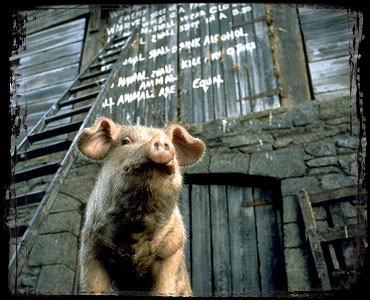
Animal Farm: Narrative Poem

Beast of England
Late one night on an English farm,
An old boar had a dream.
He gathered his fellow animals
To tell them of his scheme.
In old Major’s hopeful dream,
No humans were around.
The animals were free to rule,
And claim their piece of ground.
When old Major died,
His dream lived on within
All comrades worked together
To gain a victorious win.
Snowball and Napoleon,
Two pigs each with a snout
Led a rebellious riot
To drive the humans out.
After all was said and done,
Seven laws were written down,
Concerning the enemy –humans–
And their evil ways in town.
No animal should wear clothes
Or kill another beast.
No alcohol would be allowed
Obey these rules at least.
Two legs makes an enemy
Four legs makes a friend
All animals are equal
But then it all depends…
Craving the power for himself
Napoleon chased off Snowball
He convinced the other animals
This was better for them all.
One by one the rules were changed
Alterations made left and right
All seeming to benefit the pigs
And fill the rest with confusion and fright.
Napoleon changes one that clearly states,
No animals sleep in beds.
The new rule makes beds okay, but
Outlaws sheets instead.
All the rules are eventually lost
Power’s corruption is clear to see.
Yet the ignorant animals are oblivious
And keep on laboring readily
Late one night on an English farm,
The animals peered inside.
Napoleon had become quite human-like
Late one night on an English farm,
An old boar had a dream.
He gathered his fellow animals
To tell them of his scheme.
In old Major’s hopeful dream,
No humans were around.
The animals were free to rule,
And claim their piece of ground.
When old Major died,
His dream lived on within
All comrades worked together
To gain a victorious win.
Snowball and Napoleon,
Two pigs each with a snout
Led a rebellious riot
To drive the humans out.
After all was said and done,
Seven laws were written down,
Concerning the enemy –humans–
And their evil ways in town.
No animal should wear clothes
Or kill another beast.
No alcohol would be allowed
Obey these rules at least.
Two legs makes an enemy
Four legs makes a friend
All animals are equal
But then it all depends…
Craving the power for himself
Napoleon chased off Snowball
He convinced the other animals
This was better for them all.
One by one the rules were changed
Alterations made left and right
All seeming to benefit the pigs
And fill the rest with confusion and fright.
Napoleon changes one that clearly states,
No animals sleep in beds.
The new rule makes beds okay, but
Outlaws sheets instead.
All the rules are eventually lost
Power’s corruption is clear to see.
Yet the ignorant animals are oblivious
And keep on laboring readily
Late one night on an English farm,
The animals peered inside.
Napoleon had become quite human-like
And old Major’s dream had died.
Friday, December 4, 2009
Poetry Out Loud Performances: "Frederick Douglass"
Shawntay A. Henry's performance of the poem "Frederick Douglass" contained many exemplary characteristics for reciting poetry. Shawntay's physical presence as she began to speak seemed strangely unsure. But after only a few words, I could see that she was trying to convey a message to the audience. Her use of hesitation every once in a while made me recognize the dramatic tone of the poem. Through hand gestures, emphasis of certain words, and clear articulation, Shawntay displayed her maturity, poise, and deep understanding of the poem. The complexity of the theme of "Frederick Douglass" was thouroughly revealed through Shawntay A. Henry's performance.
Robert E Hayden's "Frederick Douglass" portrays the importance of freedom.
Freedom is as essential to life as air. Frederick Douglass was a slave who escaped and helped with the abolition of slavery. Because of him, many black slaves became free men and women. This poem honoring Frederick Douglass explains how vital freedom is. After hearing the poem, I finally learned to appreciate how privileged I am.
Robert E Hayden's "Frederick Douglass" portrays the importance of freedom.
Freedom is as essential to life as air. Frederick Douglass was a slave who escaped and helped with the abolition of slavery. Because of him, many black slaves became free men and women. This poem honoring Frederick Douglass explains how vital freedom is. After hearing the poem, I finally learned to appreciate how privileged I am.
Wednesday, November 18, 2009
Mockingbird Motif
A motif is a reappearing object, idea, or arrangement in a peice of writing. Authors use motifs to show a main idea or theme throughout a novel or other writing. In To Kill a Mockingbird, for example, Harper Lee uses a reoccurring symbol throughout the novel of a mockingbird. Atticus tells his children in the story that it is a sin to kill a mockingbird. Miss Maudie adds to this by saying, "Mockingbirds don't do one thing but make music for the rest of us to enjoy." This helps enhance the mockingbird motif.
A metaphorical mockingbird is an innocent person who does things for the benefit of others. Two of the mockingbirds in the story are Tom Robinson and Boo Radley. Through revealing their similarities to mockingbirds, Harper Lee creates a closer feel for their lifestyles. A black man, Tom Robinson tries to do nothing but innocently help Mayella Ewell and is found guilty of raping her. Tom is a victim of unjust prejudice. Boo Radley stays in his house day after day, not harming anybody, but (if anything) helping them. Boo Radley helps Scout to grow in acceptance and understanding of differences. He helps her also to comprehend Atticus's words that she'd never understand another person until she stood in their shoes. These are just two examples of mockingbirds that Harper Lee uses to emphasize the major themes of the novel.
A metaphorical mockingbird is an innocent person who does things for the benefit of others. Two of the mockingbirds in the story are Tom Robinson and Boo Radley. Through revealing their similarities to mockingbirds, Harper Lee creates a closer feel for their lifestyles. A black man, Tom Robinson tries to do nothing but innocently help Mayella Ewell and is found guilty of raping her. Tom is a victim of unjust prejudice. Boo Radley stays in his house day after day, not harming anybody, but (if anything) helping them. Boo Radley helps Scout to grow in acceptance and understanding of differences. He helps her also to comprehend Atticus's words that she'd never understand another person until she stood in their shoes. These are just two examples of mockingbirds that Harper Lee uses to emphasize the major themes of the novel.
Saturday, November 14, 2009
Scout: Compassion

In the selection I read of the dramatic reading, Scout realizes how Mayella Ewell "must have been the loneliest person in the world." And, as Tom Robinson continues his testimony, Scout sees that he will be punished for nothing but showing kindness to Mayella. Scout becomes compassionate toward Tom, but at the same time takes some pity on Mayella Ewell. The hands represent the sympathy Scout feels for others, even if the rest of Maycomb is too prejudiced to have kind feelings.
Friday, November 6, 2009
Life Lessons
I was only six when my sister left for college. As her nerves were building when she was preparing to move out, it seems everyone had some sort of advice for her. One of these helpful hints is perhaps the best life lesson I have ever learned. A saying my grandma often said was, "To have a friend, you have to be a friend." Although I didn't realize it at the time, my grandmother's simple yet wise cliché is something I will have with me for the rest of my life.
This powerful phrase is a motto that I do my best to follow. Whenever I don't know how to handle a situation, I can turn to this lesson, and my life becomes clearer. As I have grown older, I have realized how much an easy task such as being a friend can impact my life and the lives of people around me. Sometimes all people need is someone to be there, through thick and thin, including me. A friend will cheer me up on a bad day and laugh with meon a good day. A friend will be there for me when times are rough. And the best way to have someone there for me is to be there for them.
This powerful phrase is a motto that I do my best to follow. Whenever I don't know how to handle a situation, I can turn to this lesson, and my life becomes clearer. As I have grown older, I have realized how much an easy task such as being a friend can impact my life and the lives of people around me. Sometimes all people need is someone to be there, through thick and thin, including me. A friend will cheer me up on a bad day and laugh with meon a good day. A friend will be there for me when times are rough. And the best way to have someone there for me is to be there for them.
Subscribe to:
Comments (Atom)